Online Friction Calculator: Make Friction Problems Easy
Friction is a common but basic topic in physics, just like momentum, which you can understand better using a momentum calculator. We see its importance every day but it can be hard to calculate. When you run or push a heavy box, feel friction. Friction is everywhere. But solving friction questions in homework or exams can feel confusing.
This is where an online friction calculator helps. It makes the math simple and easy. It helps you feel relaxed. With this tool, you can understand the idea without worrying about the numbers. Step by step explanation in easy words is as below:
What Is Friction, Anyway?
It is a force that slows things down when two surfaces touch. Where two surfaces touch, friction tries to stop one by pushing against the other.
For example, by walking, your shoes hold the floor so you don’t slip. Through bike brakes tires rub on the road to help you stop.
There are two types of friction:
Static Friction – This keeps things from moving. If you push a box and it does not move. It is usually weaker than static friction, static friction is stopping it.
Those who understand the difference between these two types find physics easy, which is why many students use an online friction calculator.
Static Friction vs Kinetic Friction: Quick Examples
Here’s a simple way to remember them:
Static Friction Example: You’re pushing a heavy cupboard. At first, it didn't budge. That’s static friction.
Kinetic Friction Example: After you finally get it moving, it slides but still resists slightly. That’s kinetic friction.
This distinction matters because the friction force depends on which type you’re dealing with.
How to Calculate Friction
The formula for friction is very simple:
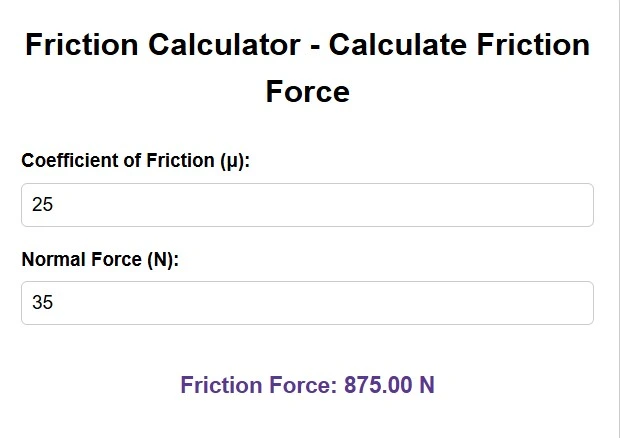
Friction Force (F) = Coefficient of Friction (μ) × Normal Force (N)
In very easy words:
μ (coefficient of friction): It tells how rough or smooth the two surfaces are. E.g shoes on the floor or rubber on wood.
N (normal force): It tells how hard the object is pushing down on the surface. E.g its weight on the floor.
By using this simple formula, find friction force using the coefficient and normal force in an easy and simple way.
Step-by-Step: Solving
The formula of finding normal force by choosing correct coefficients is simple but many students get confused. They may not know which type of friction applies. Here are an easy steps:
Read the problem carefully – Be careful about the mass, angle, coefficient of friction, and any force applied.
Decide the type of friction – static (not moving) or kinetic (moving).
Find the normal force – On a flat surface, it is just the object’s weight (mass × gravity).
On inclined planes, it’s less (weight × cosθ).
Multiply μ × N – That gives the friction force.
Check your answer – Make sure it makes sense physically.
If this feels like a lot, don’t worry—a friction calculator for homework and assignments can handle the math in seconds.
Why Use an Online Friction Calculator?
An online friction calculator is more than just a shortcut. Here’s why it’s helpful:
- Saves time – No need for messy manual calculations.
- Reduces mistakes – Especially useful when formulas involve angles or multiple forces.
- Step-by-step results – Many calculators show the solution process, so you actually learn.
- Versatile – Use for static friction, moving friction, sloped surfaces, and more.
Normal Force and Friction
The normal force is basically the surface pushing back on your object. It’s important because friction is proportional to this force. More weight = more friction.
For example, sliding a light book across a table is easy. Sliding a heavy piano? Much harder. That’s normal force at work. The cool part? A good online friction calculator automatically factors it in for you. No guesswork needed.
Friction Calculator for Students
Students often search for the best online friction calculator for physics students. A good one should:
- Allow you to input coefficients of friction and normal force.
- Handle both static and kinetic friction.
- Give step-by-step solutions.
- Be reliable for homework, assignments, or exam practice.
Using a calculator does not only give the answer but it helps you see why the numbers make sense.
Quick Tip: Difference Between Static and Kinetic Friction
Remember this table—it helps a lot:
| Friction Type | What It Does | Example |
|---|---|---|
| Static Friction | Stops objects from moving | Pushing a heavy stationary box |
| Kinetic Friction | Slows objects in motion | Sliding the box after it starts moving |
Every online friction calculator takes this into account automatically, so you get accurate results for either type.
Wrapping Up
Friction might seem simple at first, but it’s involved in so many real-life scenarios and physics problems. From understanding static vs kinetic friction to calculating the friction force using the coefficient and normal force, it takes practice to get it right.
An online friction tool is your best friend here. It saves time and helps you avoid mistakes. It also shows each step clearly, so physics feels much easier. So if you get stuck on a friction question, don’t worry—the answer is just one click away.