Is 36 a Perfect Cube? Step-by-Step Explanation
A question comes to many students' and math learners' minds, “Is 36 a perfect cube or not?”
Perfect cubes are useful for solving:
- Cube roots
- Algebra problems
- Better mental math
We will discuss whether 36 is a perfect cube or not. We will use simple examples and easy steps so that the learner can understand.
What Is a Perfect Cube?
When the same number is multiplied by itself three times, you get its perfect cube.
Examples:
- 2 multiplied by itself three times gives 8
- 3 multiplied by itself three times gives 27
- 5 multiplied by itself three times gives 125
Is 36 a Perfect Cube?
Let’s check:
Since it is not a whole number.
No whole number makes 36 after multiplying by itself three times.
How to Check Without a Calculator
You can also verify using simple steps:
Try to group factors in sets of three identical numbers.
If grouping perfectly into sets of three is not possible → not a perfect cube.
Prime Factor Method
Breaking 36 into prime factors gives: 36 = 2² × 3²
- A perfect cube requires each prime factor’s exponent to be a multiple of 3
- Here, 2² → exponent 2, 3² → exponent 2 → neither is a multiple of 3
- Therefore, 36 fails the prime factor check
Step-by-Step Method Using Approximation
Another way for quick mental math:
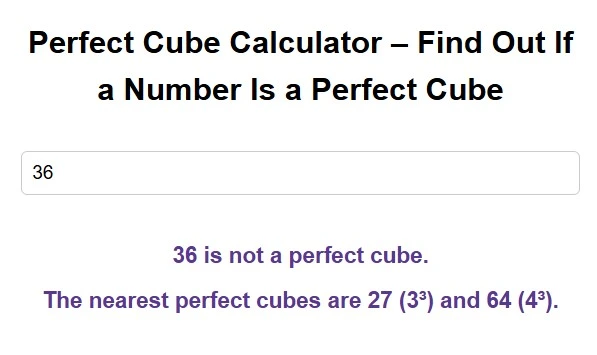
- Identify nearest perfect cubes: 27 (3³) and 64 (4³)
- Check if 36 lies exactly between cubes → No, it’s not equal to 27 or 64
- Conclude → 36 is not a perfect cube
Why Understanding Perfect Cubes Is Important
Learning perfect cubes helps in:
- Solving cube root problems easily
- Simplifying algebraic expressions
- Performing faster mental math in exams
- Understanding geometric volumes related to cubes
This knowledge is particularly helpful for students from grade 6–10 and for anyone preparing for competitive exams.
Quick Reference: Small Perfect Cubes
- 1³ = 1
- 2³ = 8
- 3³ = 27
- 4³ = 64
- 5³ = 125
- 6³ = 216
Tip: If your required number does not match this list of cubes, then it is not a perfect cube.
FAQs
Q1: Can negative numbers be perfect cubes?
Yes! It can also be a perfect cube
(-3) × (-3) × (-3) = -27 so -27 is a perfect cube.
Q2: How to quickly check if a number is a perfect cube?
- Use cube roots
- Factorize into primes
- Check for triplet grouping
Q3: Is 36 a perfect square too?
Example:
6 multiply 6 = 36 perfect square
6 multiply 6 multiply 6 = 216, so 36 is not a perfect cube.
Final Answer
36 is not a perfect cube because its cube root is not an integer, and its prime factorization cannot form triplets.
For instant verification of any number, try our Perfect Cube Calculator — fast, accurate, and helpful for learning.